DEEPX AI Acceleration for Raspberry Pi 5: DX-M1 Today, DX-M2 Next
Real-time vision on DX-M1 today. On-device generative AI on DX-M2 next. One partner, one toolchain, from first HAT to custom hardware.
Sixfab builds the boards that put DEEPX silicon on a Raspberry Pi, and designs the custom hardware that takes it to production.
Start with a board or a HAT
Add 25 TOPS of DEEPX acceleration to a Raspberry Pi 5 without designing anything. Off the shelf, documented, shipping now.
Take it from prototype to product
Branded derivative, semi-custom board, or a fully custom design. We do the electrical, RF, thermal, certification and manufacturing.
DEEPX Builds the Silicon. Sixfab Builds Everything Around It.
DEEPX Co., Ltd. is a Korean edge AI semiconductor company building neural processing units for on-device inference. Its DX-M1, an M.2 accelerator, delivers 25 TOPS of INT8 compute for real-time computer vision.
Sixfab is DEEPX’s platform partner for Raspberry Pi and single-board computers. We take that silicon and turn it into working hardware: we design the carrier boards, validate the thermals, ship the product, maintain the documentation, and publish our own benchmarks on real Raspberry Pi 5 hardware.
The partnership works in both directions. DEEPX reaches the most widely deployed single-board computer in the world. Our customers get silicon with a roadmap behind it, from a vendor with a named foundry partner and a clear path from vision to generative AI.
Shipping today: DX-M1M & DX-M1 on Raspberry Pi 5
Two Sixfab products put DEEPX silicon on a Raspberry Pi 5 right now. Both are in production, both are documented, and both run the same DEEPX toolchain.
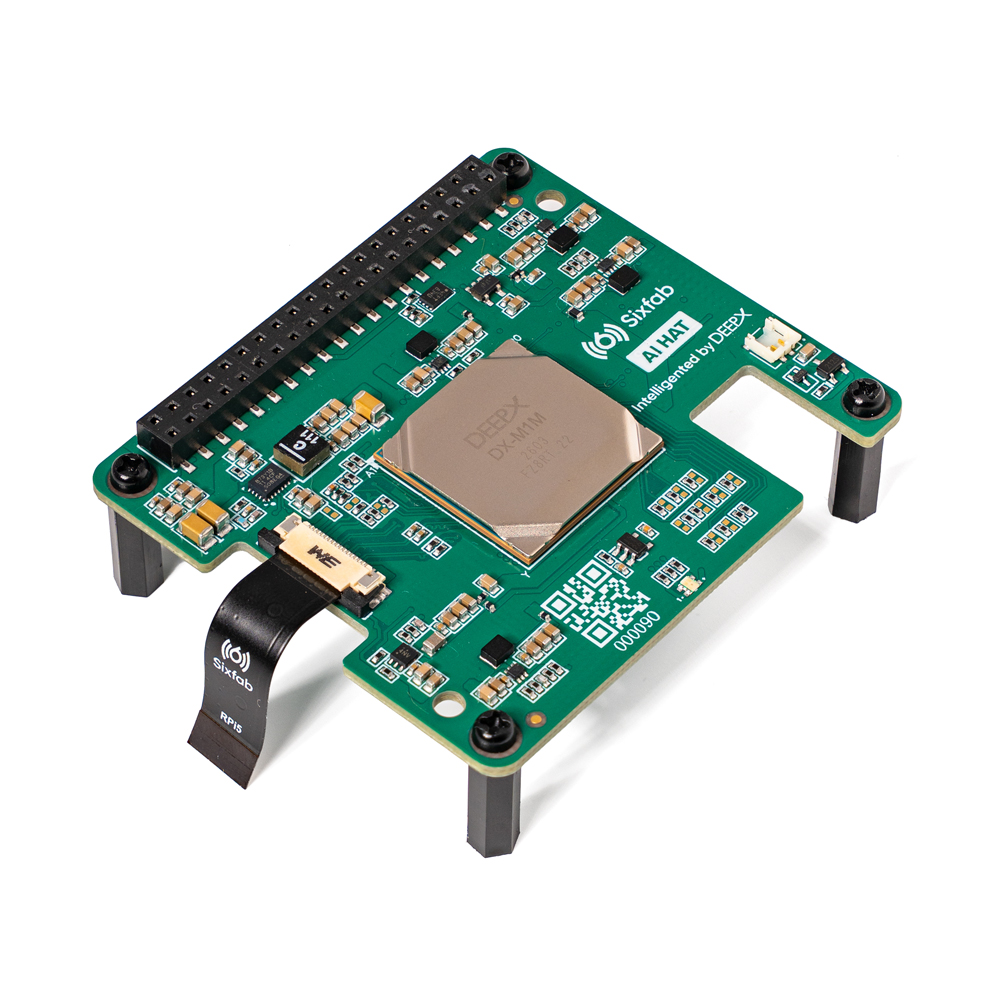
Sixfab AI HAT+ for Raspberry Pi 5
What it isA compact HAT carrying the DEEPX DX-M1M. Adds real-time inference to a Pi 5 build with nothing else to design.
Pick it whenYou want acceleration and nothing more. Fastest path from unboxing to a running model.
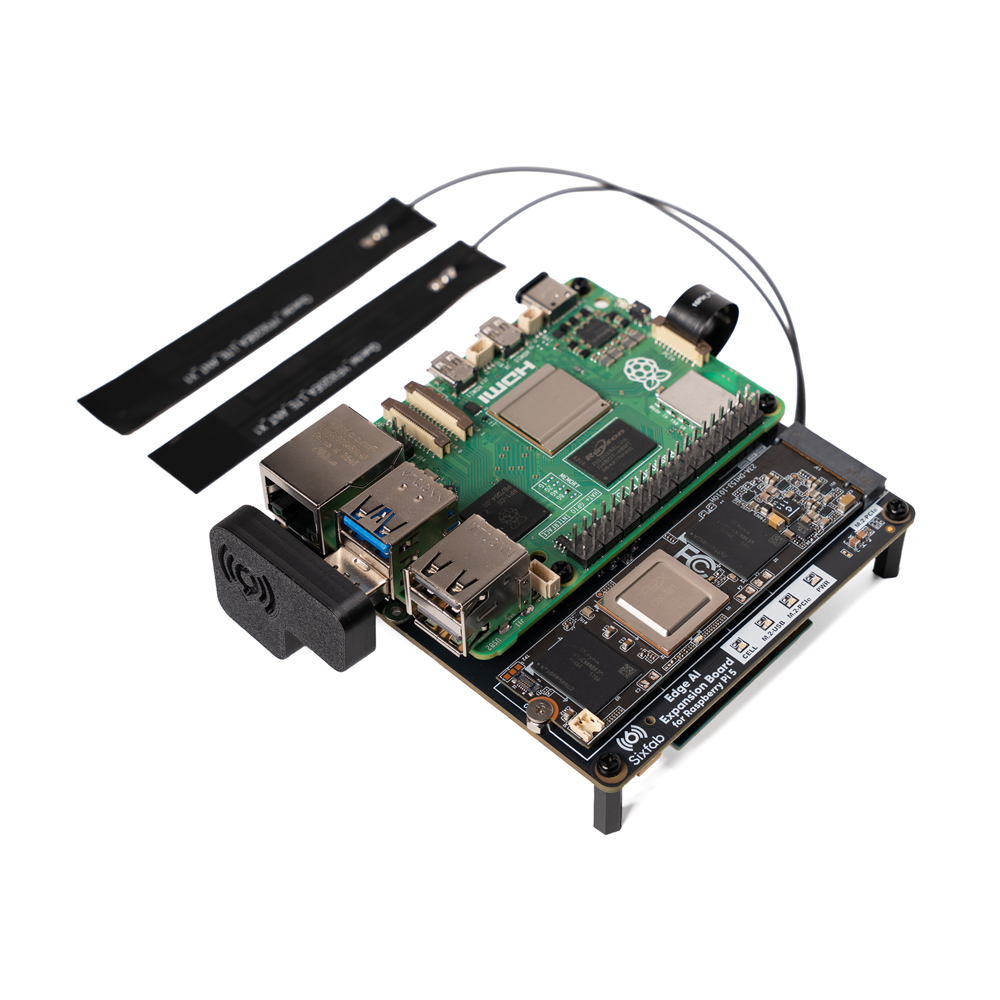
Sixfab Edge AI Expansion Board for Raspberry Pi 5
What it isA carrier that combines DEEPX DX-M1 with NVMe storage and LTE or 5G connectivity on a single USB-C power system.
Pick it whenThe node has to run headless in the field and report over a mobile network.
Why we ship DEEPX
DEEPX has broad industry adoption, with modules and boards available from several hardware makers. We build on it because, for the workloads our customers run, it delivered the strongest results we measured.
Throughput on detection models
On a Raspberry Pi 5, the DX-M1M pushes 50.1 FPS on YOLOv8l in async NPU mode, against 19.6 FPS for the Hailo-8: more than 2.5× the throughput. On YOLOv8x it reaches 34.1 FPS against 13.5, again more than 2.5×. On YOLO26n, 178.7 against 96.7.
Cost per frame
DEEPX delivers the lowest cost per frame per second of any accelerator we have benchmarked on this host.
Framework support built for developers
DX-M1 accepts ONNX and compiles with DEEPX’s DX-COM toolchain. For Ultralytics YOLO models the export is a single command, because DEEPX is a first-class Ultralytics export target. PyTorch, TensorFlow and Keras all reach it through ONNX. There is no proprietary training format to adopt and no model zoo you are locked inside.
Memory behaviour that matters in production
The DX-M1M carries its own onboard NPU RAM and keeps model weights there. Host memory use stayed near 22 MB regardless of workload in our testing, leaving the Pi’s RAM free for your application.
How DEEPX compares: M.2 AI accelerators at a glance
Five accelerators, one socket, very different tradeoffs. Here’s how DEEPX sits among them.
| AI Accelerator | TOPS | Watts | M.2 Key/Size | Price | Pi 5 Support | Framework Support | Compilation Ease |
|---|---|---|---|---|---|---|---|
| DEEPX DX-M1 | 25 | 6.36W avg (Expansion board level consumption) | M-Key: 2280 | $190 | Yes | ONNX, Ultralytics YOLO, PyTorch, TensorFlow, Keras | 2nd easiest |
| Hailo-8 | 26 INT8 | 6.53W avg (board-level) | M-Key & B+M: 2242/2260/2280, A+E: 2230 | ~$110 (bundled) | Yes | TensorFlow, TensorFlow Lite, Keras, PyTorch, ONNX | 3rd |
| Hailo-8L | 13 INT8 | 6.08W avg (board-level) | B+M: 2242/2260/2280; A+E: 2230 | ~$70 (bundled) | Yes | Same as Hailo-8 | 3rd |
| MemryX MX3 | 24 | 6–8W typical | M.2 M-key 2280 | $149 | Yes, via M-key 2280 HAT | Keras, TF, TFLite, ONNX (PyTorch via ONNX) | Easiest |
| Axelera Metis | 214 | 3.5–9W operating | M.2 2280 M-key | $249–$299 | Yes, via M-key 2280 HAT | PyTorch (native); Voyager SDK (Apache TVM) | Hardest |
Power figures marked as board-level or expansion-board-level consumption reflect the measurement scope stated in the table. Prices are indicative and should be checked against current product listings before purchase.
Last verified: October 2026.
How to choose, by workload
High-throughput object detection
Look at measured frames per second on your actual model, not headline TOPS. The DX-M1M led on YOLOv8l (50.1 FPS vs 19.6 for the Hailo-8), YOLOv8x (34.1 vs 13.5) and YOLO26n (178.7 vs 96.7). For YOLO-class detection, it’s the module to beat.
Semantic segmentation
On DeepLabV3, the Hailo-8 currently posts higher numbers (121.9 vs 34.5 FPS). Where segmentation sits alongside detection, the DX-M1M handles both on a single toolchain.
On-device generative AI and local LLMs
This needs onboard memory and transformer decoder support, which most accelerators in this class do not have. DX-M1 is purpose-built for computer vision. For generative AI, DEEPX has designed a dedicated chip, DX-M2, rather than compromising one design for both. Today, the Hailo-10H runs small LLMs on device with 8 GB of onboard RAM. See the roadmap below.
Power draw
Compare frames per watt, not watts alone. Among 25-TOPS-class modules, the DX-M1M draws less than the Hailo-8 (6.36 W vs 6.53 W). The Hailo-8L draws 6.08 W at roughly half the rated compute (13 TOPS). Coral draws roughly 2 W at 4 TOPS and runs TensorFlow Lite only.
How easily your model compiles
For Ultralytics YOLO, DEEPX is a native export target: one command. Across frameworks, MemryX and DEEPX are the most straightforward to compile for, followed by Hailo and Axelera. Coral is straightforward but accepts TensorFlow Lite only. Confirm your export path before you commit to any of them.
Where other accelerators fit
Some workloads favour a different design. Here’s where.
Segmentation-heavy pipelines
The Hailo-8 currently posts higher DeepLabV3 numbers than the DX-M1M.
Single-stream efficiency
In a single-stream pipeline, all four boards we measured land within half a frame per watt of each other, because the Raspberry Pi 5’s software decoder rather than the accelerator sets the frame rate. The DX-M1M’s throughput headroom becomes an efficiency advantage in multi-camera, multi-model or camera-direct setups. The full methodology is in the benchmark.
Local generative AI today
The Hailo-10H runs small LLMs and vision-language models on device today. DEEPX’s answer is DX-M2.
The roadmap: DX-M1 today, DX-M2 next
DX-M1 is purpose-built for real-time computer vision. DX-M2 is DEEPX’s dedicated chip for generative AI, and it is the reason this is a platform rather than a product.
What DEEPX has published about DX-M2
All figures below are DEEPX’s own published specifications and are subject to change without notice.
Why this matters if you are choosing silicon now
Most edge AI hardware decisions are made for vision workloads, then revisited eighteen months later when someone asks whether the device can run a language model. At that point most teams are choosing a new vendor, a new toolchain and a new board.
Standardising on DEEPX means the vision chip and the generative chip share a vendor, a roadmap and a toolchain, so a new requirement does not force a platform migration. DEEPX positions DX-M2 around lowering the cost of local inference against paying per API call. We are building toward it with DEEPX.
From prototype to production
A HAT gets you to a working demo. Getting to a product is a different problem: enclosure, thermals, certification, supply, and a bill of materials you can still buy in three years. Sixfab designs and manufactures that hardware.
There are three ways to work with us, and they differ mainly in how much of the board is yours.
Configure and brand
Our existing hardware, your branding and configuration. Fastest route to a shippable product.
Semi-custom derivative
We take a proven Sixfab design and change what your application needs: connectors, form factor, interfaces, power.
Fully custom design
A board designed around your requirements from the start, with accelerator selection as part of the engagement.
We cover electrical design, RF and antenna integration, mechanical and thermal design, power systems, AI enablement, display and HMI, certification and compliance, and manufacturing through to lifecycle management. We are also clear about where our scope ends, which is set out in full on the design services page.
Accelerator selection is part of the work. DEEPX is our default for detection-heavy programs, for the reasons above, and every engagement is scoped to your workload.
Which single-board computers the DX-M1 runs on
Raspberry Pi 5 is the platform we build for and the one we benchmark on. The DX-M1M connects over PCIe through a Sixfab carrier, either the AI HAT+ or the Edge AI Expansion Board. Getting full throughput requires PCIe Gen 3 to be enabled on the host, which is a one-line change covered in our documentation.
Raspberry Pi 4, CM4 and CM5 are not supported configurations for the DX-M1 on Sixfab hardware.
Other single-board computers. The DX-M1M is an M.2 M-key 2280 module, so it is not architecturally tied to the Raspberry Pi. Radxa ships its AICore DX-M1M on the same silicon, and the module will work with other hosts that expose a suitable M.2 M-key slot with enough PCIe bandwidth and power headroom. We validate and support the Raspberry Pi path. For anything else, talk to us.
FAQ
What is DEEPX?
DEEPX Co., Ltd. is a Korean semiconductor company that designs neural processing units for edge AI inference. Its current production chip, the DX-M1, is an M.2 module delivering 25 TOPS of INT8 compute for real-time computer vision on host boards such as the Raspberry Pi 5. Its next chip, DX-M2, is being developed on Samsung Foundry’s 2 nm process for on-device generative AI, with mass production targeted for 2027. DEEPX is not related to DeepX Inc. of Japan or to deepxhub.com.
What is the DEEPX DX-M1?
The DX-M1 is an M.2 AI accelerator module that delivers 25 TOPS of INT8 compute for neural network inference. It plugs into an M.2 M-key 2280 slot and runs object detection, classification and segmentation on its own silicon rather than on the host CPU. The DX-M1M variant carries onboard NPU RAM, so model weights stay on the module instead of consuming host memory. On a Raspberry Pi 5 it delivers 50.1 FPS on YOLOv8l in async NPU mode.
Does DEEPX work with Raspberry Pi 5?
Yes. The DEEPX DX-M1M runs on a Raspberry Pi 5 through a carrier board that exposes the Pi’s PCIe interface as an M.2 M-key slot. Sixfab ships two: the AI HAT+ and the Edge AI Expansion Board. Enabling PCIe Gen 3 on the host is required for full throughput.
Which AI accelerator is best for my workload?
It depends on the workload. For YOLO-class object detection on a Raspberry Pi 5, the DEEPX DX-M1M leads: 50.1 FPS on YOLOv8l in async NPU mode against 19.6 for the Hailo-8. For segmentation-heavy or on-device LLM workloads, other modules may fit today; our benchmark has model-by-model results.
Is DEEPX better than Hailo?
For object detection on a Raspberry Pi 5, DEEPX leads by more than 2.5× on YOLOv8l and YOLOv8x, headroom that matters most in multi-camera and multi-model pipelines. Hailo currently posts higher segmentation numbers, and its Hailo-10H runs small LLMs today, a role DEEPX addresses with DX-M2. Full model-by-model results are in our published benchmark.
Does DEEPX support LLMs?
DX-M1 is purpose-built for computer vision. For language models, DEEPX has developed DX-M2, a dedicated generative AI chip targeting models up to 20 billion parameters under 5 W, with mass production targeted for 2027.
How do I get a model onto a DEEPX accelerator?
DX-M1 accepts ONNX and compiles it to a .dxnn binary using DEEPX’s DX-COM compiler. Ultralytics YOLO models export directly, because DEEPX is a supported Ultralytics export target. Models from PyTorch, TensorFlow and Keras reach the accelerator by converting to ONNX first. Full instructions are in the Sixfab developer documentation.
Can Sixfab design custom edge AI hardware?
Yes. Sixfab designs and manufactures custom edge AI hardware, covering electrical design, RF and antenna integration, mechanical and thermal design, power systems, certification and compliance, and manufacturing. There are three engagement models: configure and brand our existing hardware, a semi-custom derivative of a proven Sixfab design, or a fully custom board designed around your requirements.
Can I get a DEEPX-based board at volume?
Yes. Sixfab supplies DEEPX-based hardware at production volume, either as existing products or as custom designs. Accelerator selection, carrier design, certification and manufacturing are all in scope. Start with a design conversation and we will scope it against your volume, workload and timeline.
Where do you want to start?
Get building
Add DEEPX acceleration to a Raspberry Pi 5 today with hardware that is documented and in stock.
View the hardware →Get to production
Tell us what you are building: the workload, the volume, the timeline. We’ll show you how DEEPX fits your workload and what it takes to get to a product.
Start a design conversation →