
If you are shopping for an AI HAT for your Raspberry Pi 5 right now, you are choosing between two families: the Sixfab AI HAT+ built around the DEEPX DX-M1M, and the Hailo lineup on the Raspberry Pi AI HAT+ and AI HAT+ 2. Prices run from $63 for the entry Sixfab board to $200 for the Raspberry Pi AI HAT+ 2. We put them on the same bench and measured what they deliver, not what the spec sheets promise.
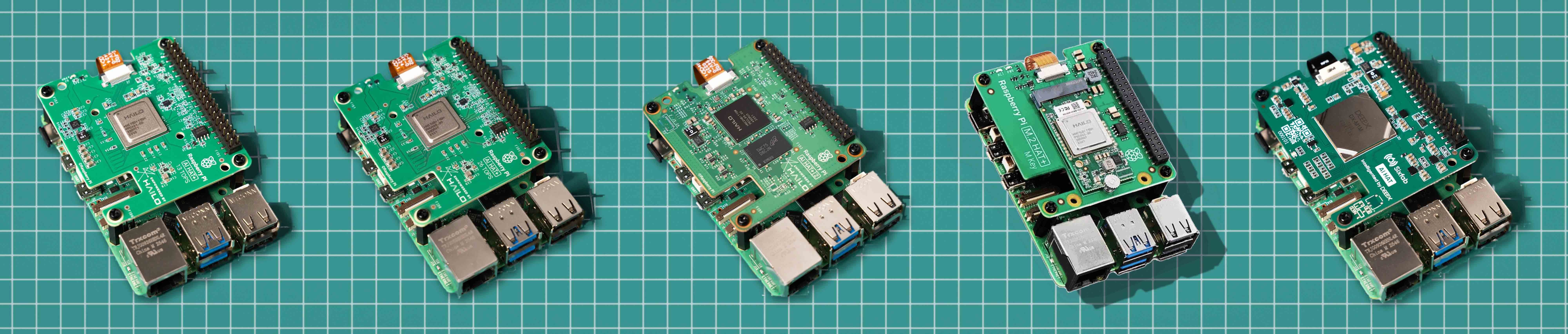
The TOPS figure every edge AI chip maker puts front and center tells you very little on its own. A rating cannot predict what happens once a real video stream is decoded on the Raspberry Pi 5, preprocessed on the CPU, pushed through the NPU, and parsed on the way out. So we ran all four chips on one Raspberry Pi 5 and measured object detection, classification, segmentation, power, heat and cost per frame.
Quick verdict: which Raspberry Pi 5 AI HAT should you buy?
- Highest object-detection throughput (YOLOv8): Sixfab AI HAT+ (DEEPX DX-M1M), 50.1 FPS on YOLOv8l, 156% ahead of the Raspberry Pi AI HAT+ (Hailo-8).
- Best vision performance per dollar: Sixfab AI HAT+, 25 TOPS INT8 for $95 or 13 TOPS for $63, undercutting every Hailo board.
- Best end-to-end efficiency (FPS per watt): Raspberry Pi AI HAT+ (Hailo-8), narrowly. It edges detection at 1.74 FPS per watt against 1.69 for the Sixfab AI HAT+ (DEEPX), and ties the Hailo-8L on classification and segmentation. In a single-stream pipeline all four boards land inside half a frame per watt of each other.
- Lowest power and coolest running: Raspberry Pi AI HAT+ with Hailo-8L, 6.08 W average and 33 to 47 C.
- Semantic segmentation (DeepLabV3): Raspberry Pi AI HAT+ with Hailo-8, 121.9 FPS.
- Local generative AI (small LLMs and VLMs): Raspberry Pi AI HAT+ 2 (Hailo-10H), the only board here with 8 GB onboard RAM and a decoder path.
- Connected, headless field deployment: the Sixfab AI HAT+ pairs with Sixfab’s cellular-native connected-edge stack for nodes that report over a mobile network.
The Raspberry Pi AI HAT lineup: which chip is in which board
The names are easy to confuse, so here is the map. This is the reference the rest of the article builds on.
| Retail product | Silicon | TOPS | Onboard NPU RAM | Generative AI | Price |
|---|---|---|---|---|---|
| Raspberry Pi AI Kit | Hailo-8L (M.2) | 13 (INT8) | None (uses Pi 5 RAM) | No | Discontinued |
| Raspberry Pi AI HAT+ | Hailo-8L | 13 (INT8) | None (uses Pi 5 RAM) | No | $70 |
| Raspberry Pi AI HAT+ | Hailo-8 | 26 (INT8) | None (uses Pi 5 RAM) | No | $110 |
| Raspberry Pi AI HAT+ 2 | Hailo-10H | up to 40 (INT4) | 8 GB LPDDR4X | Yes, small LLMs and VLMs | $200 |
| Sixfab AI HAT+ for Raspberry Pi 5 | DEEPX DX-M1ML | 13 (INT8) | Dedicated onboard LPDDR4X | No today (on roadmap) | $63 |
| Sixfab AI HAT+ for Raspberry Pi 5 | DEEPX DX-M1M | 25 (INT8) | Dedicated onboard LPDDR4X | No today (on roadmap) | $95 |
How we set up this Raspberry Pi AI HAT benchmark
One Raspberry Pi 5 with 8 GB of RAM, used for every single run. One video file, decoded the same way every time. Each model compiled through its vendor’s own toolchain: the DEEPX SDK for the DX-M1M and the Hailo Dataflow Compiler with HailoRT for the three Hailo chips. A USB-PD meter sat inline on the Pi’s USB-C supply and logged power the whole time, alongside NPU temperature, CPU load and RAM. No run throttled, and everything finished in ambient conditions, so every board got a fair shot.
| Host platform | Raspberry Pi 5, 8 GB RAM. Runs repeated on 2, 4 and 16 GB units; published figures are from the 8 GB unit. |
| Video source | snowboard.mp4, decoded identically for every chip and every run |
| Measured decode ceiling | 91 to 122 FPS on the Raspberry Pi 5, depending on model input resolution |
| SDK versions | DEEPX SDK 3.3.2 (DX-M1M). Hailo Dataflow Compiler with HailoRT 4.23.0 (Hailo-8 and Hailo-8L) and 5.3.0 (Hailo-10H). |
| NPU firmware | The latest firmware shipped with each SDK release, per chip |
| Measurement modes | Async, 8 in-flight requests (NPU throughput). Sync, single request (end-to-end FPS). |
| Power measurement | Inline USB-PD meter on the USB-C supply, whole system |
| Idle power | 3.6 to 3.9 W across all chip configurations |
| Peak power during inference | 9.2 W to 17.8 W depending on chip and model |
The AI models we tested: YOLOv8, YOLO11, YOLO26 and classification
The model list covers what people actually deploy across detection, classification and segmentation, each at the input resolution it ships with.
| Model | Task | Input resolution |
|---|---|---|
| YOLOv8l | Object detection | 640 x 640 |
| YOLOv8x | Object detection | 640 x 640 |
| YOLO11l | Object detection | 640 x 640 |
| YOLO26n | Object detection | 640 x 640 |
| EfficientNet-Lite0 | Classification | 224 x 224 |
| MobileNetV2 | Classification | 224 x 224 |
| DeepLabV3 | Segmentation | 512 x 512 (DEEPX) / 513 x 513 (Hailo) |
For every combination we recorded NPU throughput in async mode with 8 in-flight requests, and end-to-end FPS in sync mode that runs the whole chain, decode to parsed output. That last one is the only number your finished product will ever see, so keep it in mind whenever a datasheet tries to impress you.
Hailo-8 AI HAT+ vs M.2 AI Kit: does the form factor change performance?
We ran the Hailo-8 in both HAT and M.2 form factors, expecting maybe a small difference. There was not one. All seven models landed within 0.1 percent of each other. The connector is irrelevant; the silicon is everything. The Raspberry Pi AI Kit is the Hailo-8L on an M.2 module, the AI HAT+ is a HAT board, and the Sixfab AI HAT+ solders the DEEPX accelerator on-board with a PCIe Gen 3 link over an FFC cable to the Pi 5.
| Model | Hailo-8 on HAT | Hailo-8 on M.2 |
|---|---|---|
| YOLOv8l | 20 | 20 |
| YOLOv8x | 14 | 14 |
| YOLO26n | 97 | 97 |
| YOLO11l | 21 | 21 |
| EfficientNet-Lite0 | 1720 | 1720 |
| MobileNetV2 | 2396 | 2400 |
| DeepLabV3 | 122 | 122 |
| Model | Hailo-8 on HAT | Hailo-8 on M.2 |
|---|---|---|
| YOLOv8l | 10 | 10 |
| YOLOv8x | 8 | 8 |
| YOLO26n | 15 | 15 |
| YOLO11l | 11 | 11 |
| EfficientNet-Lite0 | 21 | 21 |
| MobileNetV2 | 21 | 21 |
| DeepLabV3 | 9 | 9 |
Where Hailo wins: TOPS-per-watt and the INT8 vs INT4 spec gap
Up front, and honest. On paper, the Hailo-8 is the more efficient chip: roughly 10.4 TOPS per watt against 8.3 for the DEEPX DX-M1M. That is a genuine spec-sheet advantage for Hailo, and we say so plainly. It is also a paper number, which is why we kept measuring.
But spec sheets are exactly the problem. Vendors quote TOPS at whatever precision flatters them, measured however they like, so the numbers were never comparable in the first place. The Raspberry Pi AI HAT+ 2 wears the biggest badge in this group at up to 40 TOPS, but that headline is an INT4 figure, per Raspberry Pi. The DEEPX DX-M1M is 25 TOPS at INT8, a higher-precision measure. And on YOLOv8l the 25 TOPS INT8 part pushed more frames through its NPU than the 40 TOPS INT4 part managed, with a lower rating and a lower price. Once the highest-rated chip stops being the fastest chip, the rating has told you everything it is going to. From here on, we deal in measured frames per second.
Object detection: DEEPX vs Hailo on YOLOv8, YOLO11 and YOLO26
Strip everything away except pure inference, async mode, 8 requests in flight. Suddenly these chips stop looking like variations on a theme, and the DEEPX DX-M1M pulls ahead on three of the four detection models.
| Model | Sixfab DX-M1M (25 TOPS, $95) | Hailo-8 (26 TOPS, $110) | Hailo-8L (13 TOPS, $70) | Hailo-10H (AI HAT+ 2, $200) | Winner |
|---|---|---|---|---|---|
| YOLOv8l | 50.1 | 19.6 | 15.0 | 40.0 | Sixfab DEEPX (+156% vs Hailo-8) |
| YOLOv8x | 34.1 | 13.5 | 10.1 | 25.7 | Sixfab DEEPX |
| YOLO26n | 178.7 | 96.7 | 78.5 | 83.5 | Sixfab DEEPX |
| YOLO11l | 37.9 | 21.4 | 18.5 | 41.6 | Hailo-10H |
| EfficientNet-Lite0 | 1,967.7 | 1,720.0 | 142.0 | 1,812.4 | Sixfab DEEPX |
| MobileNetV2 | 2,231.3 | 2,396.2 | 175.1 | 1,626.4 | Hailo-8 |
| DeepLabV3 | 34.5 | 121.9 | 43.0 | 50.7 | Hailo-8 |
That first row is the headline of this whole article: 50.1 FPS delivered by the Sixfab AI HAT+ (DEEPX DX-M1M) against 19.6 FPS from the Raspberry Pi AI HAT+ (Hailo-8), a 156 percent gap, on the model family most vision teams reach for by default. Against the Raspberry Pi AI HAT+ 2 (Hailo-10H), the margin shrinks to 25 percent on YOLOv8l, which is an impressive result for a chip with a lower headline rating. The one detection model where DEEPX does not lead is YOLO11l, where the Hailo-10H edges it by 9 percent. It stays in the table because a benchmark should show its misses too.
Classification is a close race, and DEEPX takes the first round. On EfficientNet-Lite0, the Sixfab AI HAT+ (DEEPX DX-M1M) reached 1968 FPS while the Raspberry Pi AI HAT+ (Hailo-8) achieved 1720 FPS. On MobileNetV2 the Hailo-8 answers with a modest win, 2396 to 2231. The Hailo-8L sits far below at 142 and 175 FPS, which is not a defect, it is what a 13 TOPS budget and a lower price look like in practice. Segmentation is where the Hailo-8 is strongest: the Raspberry Pi AI HAT+ (Hailo-8) holds the lead on DeepLabV3 at 121.9 FPS while the Raspberry Pi AI HAT+ 2 (Hailo-10H) managed 50.7, the Hailo-8L 43.0 and the Sixfab AI HAT+ (DEEPX DX-M1M) 34.5. If semantic segmentation is the heart of your product, the Hailo-8 is the stronger choice today. For detection-led products, the numbers point the other way.
A real video pipeline: end-to-end FPS on Raspberry Pi 5
Now add the decode and CPU stages back. Your product has them whether you like it or not.
| Model | DEEPX DX-M1M | Hailo-8 | Hailo-8L | Hailo-10H | Winner |
|---|---|---|---|---|---|
| DeepLabV3 (seg) | 7.8 | 8.7 | 8.8 | 6.9 | Hailo-8L |
| EfficientNet-Lite0 | 19.8 | 21.2 | 19.7 | 20.8 | Hailo-8 |
| MobileNetV2 | 19.8 | 21.5 | 20.0 | 21.0 | Hailo-8 |
| YOLO11l | 10.8 | 10.8 | 9.6 | 12.1 | Hailo-10H |
| YOLO26n | 13.7 | 15.2 | 14.7 | 12.2 | Hailo-8 |
| YOLOv8l | 11.2 | 10.3 | 8.7 | 11.9 | Hailo-10H |
| YOLOv8x | 8.9 | 8.4 | 6.8 | 10.2 | Hailo-10H |
| Model | Sixfab DX-M1M | Hailo-8 | Hailo-8L | Hailo-10H | Winner |
|---|---|---|---|---|---|
| DeepLabV3 | 20.15 | 16.32 | 16.06 | 18.09 | Sixfab DEEPX |
| EfficientNet-Lite0 | 24.27 | 24.15 | 24.16 | 25.74 | Hailo-10H |
| MobileNetV2 1.0 | 24.57 | 24.27 | 24.09 | 25.43 | Hailo-10H |
| YOLO11l | 23.69 | 21.26 | 18.25 | 24.84 | Hailo-10H |
| YOLO26n | 22.81 | 20.27 | 20.23 | 21.71 | Sixfab DEEPX |
| YOLOv8l | 23.70 | 19.47 | 14.83 | 25.24 | Hailo-10H |
| YOLOv8x | 24.03 | 13.49 | 10.08 | 24.56 | Hailo-10H |
A note on the Hailo-10H. The Raspberry Pi AI HAT+ 2 is rated up to 40 TOPS at INT4, while the DEEPX DX-M1M is 25 TOPS at INT8, and the AI HAT+ 2 costs $200 against $95. The Hailo-10H leads five of the seven rows, but by only 2 to 7 percent, with a chip carrying 60 percent more rated compute and more than twice the price. The DX-M1M stays within a frame or two per second of it on every model and wins DeepLabV3 and YOLO26n outright.
Everything squeezes into a narrow band: 7 to 26 FPS in sync mode and 10 to 26 FPS in async mode. The host side of the pipeline on the Raspberry Pi 5 caps all four chips alike, well below the 91 to 122 FPS decode ceiling we measured. Look at the classification rows: barely 2 FPS separates the whole field in both modes, because at that point you are benchmarking the pipeline, not the accelerator. Patterns survive the squeeze, though. In sync mode the DX-M1M stays ahead of the Hailo-8 on the heavy detectors, and the Hailo-10H takes YOLOv8l and YOLOv8x by a far thinner margin than 40-versus-25 TOPS would suggest (11.9 against 11.2 FPS on YOLOv8l). With 8 requests in flight the DX-M1M beats the Hailo-8 on every YOLO model (23.7 against 19.5 FPS on YOLOv8l, 24.0 against 13.5 on YOLOv8x), and the Hailo-10H leads it by only 2 to 7 percent on the five models it wins.
Verdict: for one camera running one model, the chip matters less than your pipeline code does. Where it starts to matter is the moment you grow. Add a second camera, run a detector and a classifier on the same frame, or feed higher-resolution input, and the DX-M1M’s 50.1 FPS of YOLOv8l NPU headroom is money in the bank. The async table shows why: the Hailo-8 delivers 19.5 FPS end to end on YOLOv8l, essentially its entire 19.6 FPS NPU ceiling, so it has nothing left, while the DX-M1M delivers 23.7 FPS and is using less than half of its 50.1. The Hailo-10H has headroom too (25.2 of 40.0 FPS), at more than twice the price.
Power draw and heat: watts and temperatures, measured
Whole-system averages in sync mode came out tight. If your power budget is counted in tenths of a watt, the Hailo-8L earns its keep, and it ran coolest of the group too.
| Board | Average power | NPU temperature |
|---|---|---|
| Raspberry Pi AI HAT+ (Hailo-8L) | 6.08 W | 33 to 47 C (coolest) |
| Raspberry Pi AI HAT+ (Hailo-8) | 6.53 W | 39 to 51 C |
| Sixfab AI HAT+ (DEEPX DX-M1M) | 6.73 W | 42 to 57 C |
| Raspberry Pi AI HAT+ 2 (Hailo-10H) | 7.59 W | up to 68.1 C on YOLOv8x |
The Raspberry Pi AI HAT+ 2 (Hailo-10H) draws more power than the rest of the group and pays for its speed in heat. Under YOLOv8x its NPU averaged 68.1 degrees Celsius on an open bench, already past the 65-degree mark with no enclosure around it. Put it in a sealed housing and you will be shopping for a fan. The Sixfab AI HAT+ (DEEPX DX-M1M) stayed between 42 and 57 degrees across the sync runs and never crossed the threshold there. It does run a few degrees warmer than the Hailo-8 and Hailo-8L, and in async mode on YOLOv8x it averaged 66.2 degrees while pushing 34.1 FPS through the NPU. A heatsink and some airflow are a sensible budget for continuous pipelined workloads.
How much does the thermal difference matter? Very little, and the DEEPX numbers are good for what the chip delivers. The DX-M1M led NPU throughput on three of the four detection models, yet in the sync runs it sat at 42 to 57 C, only a few degrees above the Hailo-8 and Hailo-8L and well below the Raspberry Pi AI HAT+ 2, which reached up to 68.1 C. Both the DEEPX and the Hailo-8 boards run cool, no board throttled in any run, and for a normal single-stream deployment thermals should not decide this purchase. The numbers sit close together because of the pipeline itself: in sync mode the Raspberry Pi 5 decoder, not the NPU, sets the frame rate, so every accelerator spends most of each frame idle. These temperatures show how little work each NPU is asked to do in that setup, not the limit of what it can do. Ambient temperature, heatsink and airflow move the result as much as the chip does, so if you plan to run async or multi-stream workloads continuously, test inside your own housing.
A note on cooling. Thermal figures depend on the cooler, so here is what each board wore. The Raspberry Pi AI HAT+ 2 was tested with the official Raspberry Pi heatsink. Every other board was cooled with an extruded heatsink.
Which AI HAT has the best FPS per watt?
Divide the frames a board actually delivers by the watts it drew in the same run, and the wide spread of the NPU throughput table all but vanishes. The Raspberry Pi 5 decoder holds every board to the same single-stream band, so the power meter sees near-identical frame counts from all four, and the ranking comes down to which board draws slightly less to get there. Every cell below uses sync-mode end-to-end FPS and sync-mode system power from the same run; async throughput is never divided by sync watts.
| Task | DEEPX DX-M1M | Hailo-8 | Hailo-8L | Hailo-10H | Winner |
|---|---|---|---|---|---|
| Detection (YOLO avg) | 1.69 | 1.74 | 1.69 | 1.52 | Hailo-8 (by 3%) |
| Classification (EffNet + MobileNet) | 2.73 | 3.08 | 3.08 | 2.64 | Hailo-8 and Hailo-8L (tie) |
| Segmentation (DeepLabV3) | 1.25 | 1.43 | 1.43 | 1.00 | Hailo-8 and Hailo-8L (tie) |
| Task | DEEPX DX-M1M | Hailo-8 | Hailo-8L | Hailo-10H | Winner |
|---|---|---|---|---|---|
| Detection (YOLO avg) | 2.95 | 2.74 | 2.46 | 2.69 | Sixfab DEEPX (by 8%) |
| Classification (EffNet + MobileNet) | 3.39 | 3.30 | 3.55 | 3.07 | Hailo-8L |
| Segmentation (DeepLabV3) | 3.17 | 1.94 | 2.29 | 2.02 | Sixfab DEEPX |
Detection goes to the Raspberry Pi AI HAT+ (Hailo-8) at 1.74 FPS per watt, a 3 percent margin over the Sixfab AI HAT+ (DEEPX DX-M1M) and the Raspberry Pi AI HAT+ (Hailo-8L), level at 1.69, which is close to a tie. The Raspberry Pi AI HAT+ 2 (Hailo-10H) trails at 1.52, because it draws the most power for a frame rate the decoder never lets it convert. The whole detection field sits between 1.52 and 1.74 FPS per watt. Classification and segmentation both end in a dead heat between the Hailo-8 and Hailo-8L, at 3.08 and 1.43 FPS per watt respectively, with the DX-M1M behind on both.
So where does the DX-M1M’s throughput lead show up? It is still there on the NPU as headroom; a single-stream sync pipeline simply never draws on it. The DX-M1M can push 50.1 FPS of YOLOv8l through its NPU in async mode, yet in sync mode the decode and CPU stages hand it 11.2 frames a second end to end, and it burns roughly the same system watts as the Hailo-8 to deliver them. Efficiency only diverges once the NPU, not the decoder, is the bottleneck: several cameras, several models per frame, or a camera-direct input path that skips the software decoder. Measured on NPU throughput alone in async mode, the DX-M1M leads detection at 9.4 NPU FPS per watt against 5.5 for the Hailo-8, 4.8 for the Hailo-8L and 5.4 for the Hailo-10H; in sync mode, where the NPU idles between frames, even that ranking flips to the Hailo-8 at 5.6 against 4.4. For a single-stream product on this host, none of that shows up on your power meter, and the honest answer is that all four boards are within half a frame per watt of each other. The DX-M1M’s advantage is headroom, and headroom is what you spend when the project grows.
Memory and CPU load: onboard NPU RAM vs staging through Pi RAM
There is one difference no chart captures. The DX-M1M carries its own onboard NPU RAM and keeps model weights there, so host memory use hovered near 22 MB regardless of workload. The Hailo-8 and Hailo-8L stage models through the Pi’s RAM via HailoRT. With one model loaded, who cares. Load three or four on a memory-tight host and you will start caring quickly, and the math runs firmly in the DX-M1M’s favor. CPU load followed the same pattern of small gaps, all four chips averaging between roughly 26 and 29 percent, leaving most of the Raspberry Pi 5 free for your application logic.
| Board | Average CPU | Average host RAM |
|---|---|---|
| Sixfab AI HAT+ (DEEPX DX-M1M) | 29.1% | 22.0 MB |
| Raspberry Pi AI HAT+ (Hailo-8) | 28.2% | 28.0 MB |
| Raspberry Pi AI HAT+ (Hailo-8L) | 25.9% | 27.1 MB |
| Raspberry Pi AI HAT+ 2 (Hailo-10H) | 26.3% | 21.8 MB |
A note on the Raspberry Pi AI HAT+ 2 (Hailo-10H), whose 21.8 MB sits level with the DX-M1M. That is architecture, not noise: the Hailo-10H carries 8 GB of onboard LPDDR4X, so in a single-model sync run it keeps its working set off the Pi much as the DX-M1M does. It is also a different class of product. Rated up to 40 TOPS at INT4, priced at $200 and built around a decoder path for generative AI, it is not the DX-M1M’s price or performance peer. The like-for-like comparison for the Sixfab board is the Hailo-8 and Hailo-8L, the boards that stage models through Pi RAM, and against those the DX-M1M holds a 5 to 6 MB lead even with a single model loaded. Under async queuing the gap widens: eight in-flight requests added 2.5 MB of host RAM on the DX-M1M and 22 to 37 MB on the three Hailo boards, the Hailo-10H included.
What about LLMs and generative AI? Vision vs generative
Short answer: the Sixfab AI HAT+ (DEEPX) does not run large language models today, and that is the right design choice for what it does. The shipping DEEPX DX-M1M silicon is a vision-inference accelerator. It lacks transformer-decoder support and dedicates its onboard memory to vision models, so it is not built for ChatGPT-style text generation. LLM support is on the DEEPX roadmap, with no announced date.
If your project needs local generative AI, the board to buy is the Raspberry Pi AI HAT+ 2 (Hailo-10H). Its 8 GB of onboard RAM and decoder path are purpose-built for small local language models and vision-language models in the 1 to 1.5 billion parameter class, and that is a genuine capability the DEEPX board does not have today. This is a vision-versus-generative tool choice, not a better-or-worse ranking. If your workload is object detection, pose, segmentation or classification, the numbers above are the ones that matter, and the Sixfab AI HAT+ leads them at the lowest price.
Raspberry Pi AI HAT+ 2 (Hailo-10H): what 8 GB and 40 TOPS really buy
The Raspberry Pi AI HAT+ 2 is the newest board in this comparison, and it is aimed at a different job than the rest. Its Hailo-10H accelerator is rated up to 40 TOPS at INT4, and its defining spec is 8 GB of onboard LPDDR4X memory, enough to hold a small language model on the accelerator rather than in the Pi’s system RAM. That is what lets it run generative AI locally, and it is the reason to buy it.
For vision, our numbers put it in context. It won single-stream sync on YOLOv8l, YOLOv8x and YOLO11l, and it took second place to the Sixfab DX-M1M on raw YOLOv8l NPU throughput (40.0 against 50.1 FPS). It also ran the hottest of the group and drew the most power. So if generative AI is on your requirements list, the AI HAT+ 2 is the clear pick. If it is not, you are paying $200 and a thermal budget for a capability your vision project will not use.
Price and value: what each AI HAT costs, and the cost per frame
Here is the part most benchmark posts skip: what each board costs, and what that money buys in frames per second. We list every price in US dollars and divide it by throughput we actually measured, so the value comparison rests on real numbers and not on spec-sheet TOPS.
| Board | Chip | TOPS | Price | YOLOv8l FPS | $ per FPS |
|---|---|---|---|---|---|
| Sixfab AI HAT+ | DEEPX DX-M1M | 25 (INT8) | $95 | 50.1 | $1.90 |
| Sixfab AI HAT+ | DEEPX DX-M1ML | 13 (INT8) | $63 | not benchmarked | – |
| Raspberry Pi AI HAT+ 2 | Hailo-10H | up to 40 (INT4) | $200 | 40.0 | $5.00 |
| Raspberry Pi AI HAT+ | Hailo-8 | 26 (INT8) | $110 | 19.6 | $5.61 |
On YOLOv8l the Sixfab AI HAT+ (DEEPX DX-M1M) is the cheapest of the three and the fastest of the three at the same time, a rare combination, so it leads cost per frame outright: about $1.90 per frame per second, against $5.00 for the Raspberry Pi AI HAT+ 2 and about $5.61 for the Hailo-8 board. Measured on the workload it targets, vision detection, it costs about 60 percent less per frame than the AI HAT+ 2 and about a third as much as the older Hailo-8 board. The $63 DX-M1ML sits below all of them at 13 TOPS for projects where the model is light and the budget is the whole conversation; we did not run it through this FPS benchmark, so we do not quote a frame figure for it.
Our honest buying advice: which Raspberry Pi AI HAT is right for you?
Sixfab AI HAT+ (DEEPX DX-M1M)
The pick for YOLO-class detection, for multi-stream or multi-model plans, and for the group’s best detection FPS per dollar. It runs a little warmer than the Hailo-8 and Hailo-8L, so give it a heatsink for sustained async workloads. Not for generative AI.
Raspberry Pi AI HAT+ 2 (Hailo-10H)
The pick if you need local generative AI: small LLMs and vision-language models on-device. Also the single-stream sync leader on YOLOv8l, YOLOv8x and YOLO11l, at the highest power draw and heat.
Raspberry Pi AI HAT+ (Hailo-8)
The pick if DeepLabV3-style segmentation drives your product, if end-to-end FPS per watt in a single-stream pipeline is the number you optimize, or if the biggest pre-compiled model zoo and community matter to you.
Raspberry Pi AI HAT+ (Hailo-8L)
Wins when the power and thermal budget is the whole conversation and your models are light: lowest draw at 6.08 W and coolest at 33 to 47 C.
Frequently asked questions
Can the Sixfab AI HAT+ (DEEPX) run LLMs or ChatGPT-style models locally?
No, not today. The Sixfab AI HAT+ for Raspberry Pi 5 is a vision-inference accelerator. The shipping DEEPX DX-M1M silicon lacks transformer-decoder support and dedicates its onboard memory to vision models, so it does not run generative chatbots. LLM support is on the DEEPX roadmap with no announced date. For local text generation today, the Raspberry Pi AI HAT+ 2 is the board to choose.
Sixfab AI HAT+ (DEEPX DX-M1M) vs Raspberry Pi AI HAT+ 2 (Hailo-10H): which should I buy?
Buy on workload. For computer vision the Sixfab AI HAT+ wins on throughput and price: 50.1 FPS on YOLOv8l against 19.6 for the Hailo-8 and 40.0 for the Hailo-10H, at $95. For running small local LLMs or vision-language models, buy the Raspberry Pi AI HAT+ 2, the only board here with 8 GB onboard RAM and a decoder path, at $200. They target different jobs.
Is DEEPX faster than Hailo on a Raspberry Pi 5?
For object detection, mostly yes. The Sixfab AI HAT+ (DEEPX DX-M1M, 25 TOPS) hit 50.1 FPS on YOLOv8l against 19.6 FPS for the Hailo-8, a 156% lead, and it also led YOLOv8x and YOLO26n. The Hailo-10H edges it on YOLO11l, and the Hailo-8 clearly wins segmentation (DeepLabV3, 121.9 FPS). Faster depends on the model.
Which AI HAT is fastest on a Raspberry Pi 5?
It depends on the task. For YOLO object detection the Sixfab AI HAT+ (DEEPX DX-M1M) is fastest, at 50.1 FPS on YOLOv8l. For semantic segmentation the Raspberry Pi AI HAT+ with Hailo-8 leads at 121.9 FPS. In a full video pipeline the Raspberry Pi 5 decoder caps every board to roughly 7 to 26 FPS, so real-world speed is often software-bound, not NPU-bound.
Is 40 TOPS (INT4) really more than 25 TOPS (INT8)?
Not on a like-for-like basis. The Raspberry Pi AI HAT+ 2 is rated up to 40 TOPS at INT4, per Raspberry Pi. The Sixfab AI HAT+ (DX-M1M) is 25 TOPS at INT8, a higher-precision number. TOPS across different precisions and vendors is not directly comparable, which is why this article benchmarks real models instead of trusting the headline rating.
Which Raspberry Pi AI accelerator is most power efficient?
It depends on what you measure. For raw low power the Raspberry Pi AI HAT+ with Hailo-8L draws the least, 6.08 W average, and runs coolest at 33 to 47 C. For end-to-end FPS per watt in a single-stream sync pipeline the Raspberry Pi AI HAT+ with Hailo-8 leads narrowly: 1.74 FPS per watt on detection against 1.69 for the Sixfab AI HAT+ (DEEPX) and the Hailo-8L, and it ties the Hailo-8L on classification (3.08) and segmentation (1.43). The whole field sits within half a frame per watt because the Raspberry Pi 5 decoder, not the accelerator, sets the frame rate. The DEEPX board’s NPU throughput lead only becomes an efficiency lead when the NPU is the bottleneck, such as multi-camera or multi-model pipelines.
Which AI HAT is the best value for computer vision?
The Sixfab AI HAT+ offers the best vision value: 25 TOPS INT8 for $95 (DX-M1M) or 13 TOPS for $63 (DX-M1ML), both undercutting the Hailo boards while leading on detection throughput, at about $1.90 per YOLOv8l frame per second against $5.00 for the Raspberry Pi AI HAT+ 2 and about $5.61 for the Hailo-8 board. If your project is object detection, pose or classification and does not need generative AI, it delivers the most frames per dollar of the boards we tested.
Is the Sixfab AI HAT+ good for YOLO object detection, and at what FPS?
Yes, this is its strongest use case. The Sixfab AI HAT+ (DEEPX DX-M1M) reached 50.1 FPS on YOLOv8l in NPU async mode, 156% ahead of the Hailo-8, and it also led on YOLOv8x and YOLO26n. It ships pre-compiled YOLOv8n and YOLOv8s models and supports ONNX plus Ultralytics YOLO, PyTorch, TensorFlow and Keras.
What can the Raspberry Pi AI HAT+ 2 do that the Sixfab AI HAT+ cannot?
Local generative AI. The Raspberry Pi AI HAT+ 2 (Hailo-10H) carries 8 GB of onboard RAM and a transformer-decoder path, so it can run small local language models and vision-language models in the 1 to 1.5 billion parameter class. The Sixfab AI HAT+ is a vision accelerator and does not run those workloads today. For vision, the Sixfab board is faster and cheaper.
Can a Raspberry Pi 5 run a local LLM without any accelerator?
Yes, within limits. A Raspberry Pi 5 with enough system RAM can run small quantized language models on its CPU alone, at conversational speeds for 1 to 3 billion parameter models. An NPU HAT mainly helps by accelerating the prompt-reading (prefill) stage and by freeing the CPU for other work. For heavy chat-style generation, a Pi remains a small-model device whether or not a HAT is attached.
How much onboard memory does the Sixfab AI HAT+ have, and is it enough?
The DEEPX NPU carries its own dedicated onboard LPDDR4X memory, so vision models run on the accelerator and host use stays near 22 MB of Pi RAM. For the 13 to 25 TOPS vision workloads this board targets, that is sufficient and matched to the job. It is not sized for large language models, which need the 8 GB of a Raspberry Pi AI HAT+ 2.
What power supply do I need for a Raspberry Pi 5 with an AI HAT?
Use the official Raspberry Pi 27 W USB-C power supply. A Raspberry Pi 5 with an AI HAT and peripherals can approach the limit of a smaller supply, and an undersized adapter causes throttling and instability during inference. The Sixfab AI HAT+ NPU itself is a low-power part, but the host Pi 5 is what sets the supply requirement.
Does the form factor (M.2 vs HAT) change AI performance?
No. We ran the Hailo-8 in both HAT and M.2 form factors and all seven models landed within 0.1 percent of each other. The connector does not change the result; the silicon does. The Raspberry Pi AI Kit is the Hailo-8L on an M.2 module, the AI HAT+ is a HAT board, and the Sixfab AI HAT+ solders the DEEPX accelerator on-board with a PCIe link over an FFC cable to the Pi 5.
Does the Sixfab AI HAT+ work offline and keep my data private?
Yes. The Sixfab AI HAT+ runs inference entirely on the DEEPX NPU on the Raspberry Pi 5, with no cloud, no external GPU and no internet dependency, so image and video data never leaves the device. That suits privacy-sensitive and disconnected deployments, and paired with Sixfab’s cellular connectivity products the same board supports headless edge nodes that report from the field over a mobile network.
Methodology. Benchmark conducted July 2026 on a Raspberry Pi 5 (8 GB) with a common video input across all runs. Models compiled with official vendor SDKs: DEEPX SDK 3.3.2, Hailo Dataflow Compiler with HailoRT 4.23.0 for Hailo-8 and Hailo-8L, and 5.3.0 for Hailo-10H, each running the latest NPU firmware shipped with its SDK release. Async figures use 8 in-flight requests; end-to-end figures are sync mode. FPS-per-watt figures divide sync end-to-end FPS by the average system power logged in the same sync run; async throughput is never divided by sync power. Input resolutions: 640 x 640 for YOLO models, 224 x 224 for classification, 512 x 512 (DEEPX) and 513 x 513 (Hailo) for DeepLabV3. Runs were repeated on 2 GB, 4 GB and 16 GB Raspberry Pi 5 units; published figures are from the 8 GB unit. Raspberry Pi AI HAT+ 2 rated up to 40 TOPS at INT4 per Raspberry Pi. Raspberry Pi board prices are list prices as of October 2026 (AI HAT+ 13 TOPS $70, AI HAT+ 26 TOPS $110, AI HAT+ 2 $200); reseller prices vary.
Sixfab AI HAT+ for Raspberry Pi 5. Intelligented by DEEPX. Built on Raspberry Pi.