Edge AI for Raspberry pi 5: The Sixfab AI HAT+ and Expansion board are available to order now.
Two of three ways to run edge AI on Raspberry Pi. Start wherever a project needs to, no required order.
Same chip family, same runtime, the same model runs across every product. Train once, recompile wherever you deploy, no pipeline rewrites.
The ALPON™ X5 AI won a CES 2026 Best of Innovation Award in Enterprise Tech
The pitch in one line: edge AI that sees everything and sends nothing, deployment-ready without the usual complexity.
Three Market Realities That Make This Urgent
Before we talk hardware, let’s talk about why “just run it in the cloud” has quietly stopped being the obvious answer in 2026.
Reality one: GPUs are still outbooked. In November 2025, NVIDIA CEO Jensen Huang put it bluntly on the Q3 earnings call, “cloud GPUs are sold out.” (NVIDIA newsroom) By mid-2026, scarcity shows up everywhere you actually try to provision: cloud providers are rationing capacity through quotas, queues, and future-dated reservations, making the real cost of cloud inference a function of availability, not just a per-token price. (HTEC inference gap analysis) An NPU doing the same bounded job at the edge costs pennies per hour in electricity, not dollars per thousand inferences. The edge only wins for the right workloads, of course, more on that in the limitations, but for edge AI generally, the economic tailwind is unmistakable.
Reality two: memory got expensive, fast. DRAM prices have spiked since last quarter, driven by HBM hoarding for AI servers that is pulling supply away from conventional memory. (Astute Group, IDC memory shortage analysis) Every new cloud instance and on-prem server now carries a memory surcharge. Edge devices, with their fixed memory footprints, sidestep that volatility.
Reality three: data protection rules are tightening. The EU AI Act’s remaining provisions are phasing in through August 2026, alongside data protection enforcement that’s already active across the EU and elsewhere. The pattern holds regardless of exactly how each provision lands: less raw data leaving a device is less data that needs a legal basis to move, store, or audit. On-device processing doesn’t make compliance work disappear, but it shrinks the surface area you have to manage.
Put those together and the logic gets simple: when cloud compute is rationed, memory is inflating, and data rules are tightening, the projects that win are the ones that process data on-device, on bounded hardware.
See Everything. Send Nothing.
Most edge AI pipelines still ship raw data off the device, to a local server, to the cloud, to somewhere with more compute. That has a cost: bandwidth, latency, a growing pile of footage or data sitting somewhere it can be intercepted, subpoenaed, or caught up in a compliance review, and a bill that scales with every unit added.
Sixfab’s hardware processes data where it’s captured. What leaves the device is the outcome, an open parking space, a flagged defect, a person crossing a line, not the raw feed. That’s the idea behind “see everything, send nothing”: full visibility for the system, minimal data exposure and minimal bandwidth for you. Point the same NPU at a warehouse aisle and it’s defect detection running at the speed of the line, no round trip to a data center. Mount it on an AMR and it’s perception with zero cloud round-trip latency. Bolt it to a drone and it’s onboard sensing at about 3W, no discrete GPU power budget required.
Most of the industry hands you a single accelerator and wishes you luck with the other 90%, the enclosure, the connectivity, the fleet management. Sixfab’s answer is a family of products that ties them together. Pick the one that matches your deployment, start wherever the project needs to start.
Every product is powered by Raspberry Pi and Intelligented by the DEEPX.
Meet your guinea pig: picture a team building a smart parking system. Cameras watch lots, detect open spaces, flag illegally parked cars, and feed an app that points drivers to the nearest spot. We’ll use this example throughout, though the three products below work independently, use one, use all three, or start wherever the project actually needs to start.
The Sixfab AI HAT+ is built to prove good ideas fast.
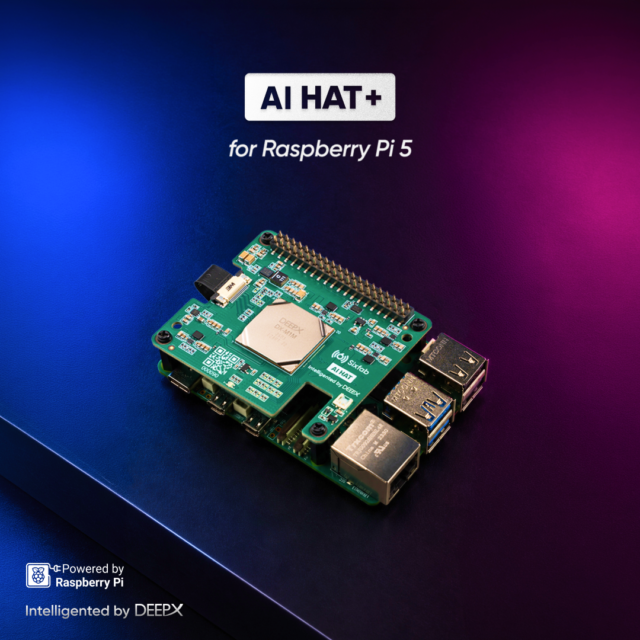
The Sixfab AI HAT+ is a HAT+ specification-compliant accelerator that mounts under the Raspberry Pi 5. It carries a DEEPX NPU soldered straight to the board, pick the DX-M1ML at 13 TOPS ($63) or the DX-M1M at 25 TOPS ($90), and talks to the Pi over PCIe Gen 3 ×1 through a 16-pin FFC cable, on a dedicated data path that doesn’t fight your USB or GPIO traffic.
What makes it a prototyping tool, not a science project:
Passive cooling. No fan, no noise, nothing to fail. The NPU draws about 2.5 to 3 W; the whole Pi 5 + AI HAT+ stack runs at 13 to 15 W on the official 27 W supply.
Real performance. YOLOv8n runs at 30 to 35 FPS at 640×640, and an 8 GB Pi 5 with the 25 TOPS module can push up to four 1080p camera streams before the Pi’s CPU pre-processing becomes the bottleneck.
First inference in ~15 minutes. Setup is the DEEPX stack via a single apt install from Sixfab’s signed repository. The HAT+ EEPROM auto-configures. Plug in, install, run a demo.
For the parking project, this is where you confirm the boring-but-critical questions: can it tell an empty space from a shadow at dusk, does it hold 30 FPS across four lot cameras. You answer all of that for the price of a nice dinner, on hardware with no cloud dependency, no external GPU, and no architectural decision you can’t carry forward. Whether the project stops here, running entirely on a $63 to $90 board, or moves into a connected deployment later, the pipeline built now carries forward unchanged, that’s a choice for later, not a requirement now.
This board turns a bench demo into something that runs in the real world, where there’s weather, no fixed network to plug into, and nobody to babysit it.
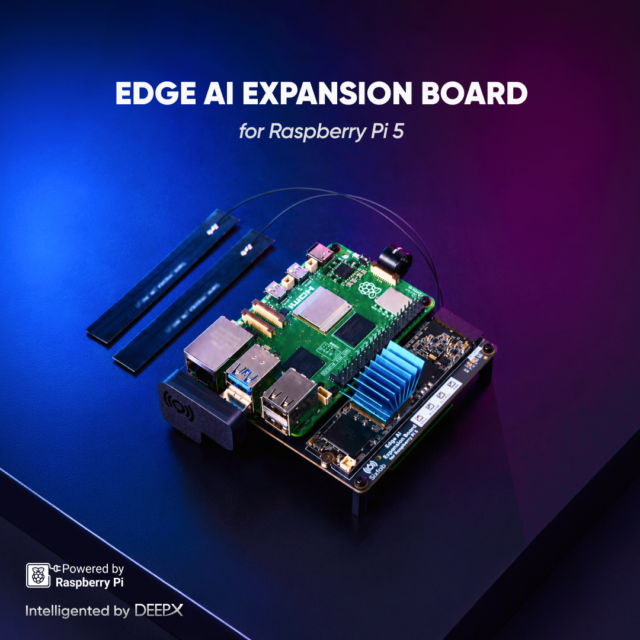
A working prototype isn’t a product. The moment your parking cameras leave the lab, three new problems appear: where does the video go, how does the system phone home, and what powers it in a parking structure with no Ethernet drop? The Edge AI Expansion Board answers all three with a triple-M.2 architecture:
AI slot: a removable DEEPX DX-M1 module (25 TOPS). Removable matters: the same silicon you tested on the bench, now on a socket instead of soldered.
Storage slot: NVMe SSD support (2230 through 2280), so detections and clips land locally at speed.
Connectivity slot: an M.2 Key-B slot for LTE/5G modems, with nano-SIM and eUICC/eSIM support. This is the connectivity angle that keeps an edge deployment online in places without a fixed network to rely on.
Power is a single USB-C PD input (27 W minimum, 45 W recommended) that back-powers the Raspberry Pi 5 through pogo pins, one cable runs the entire stack. It’s rated for 0 to 70 °C commercial range, enough for a sheltered parking cabinet during a pilot.
Pricing scales with what you need: from $60 board only, $190 with the DEEPX module included, and a cellular bundle (Coming soon).
The point of this board is zero porting effort. It runs the same DEEPX SDK and the same compiled models as the AI HAT+. The parking project takes the exact pipeline that worked on the bench, drops in the cellular modem and an NVMe drive, and puts ten units in a real lot for a month, logging footage locally, pushing only events (open spaces, violations) over LTE. Nothing about the model code changes to get here, and a project doesn’t have to touch the AI HAT+ first either, this board works as a standalone starting point too. A deployment can stay right here indefinitely. If it later needs fleet scale, that’s a separate, standalone choice, not a required next step.
This is the thing every dev kit quietly refuses to do: run 24/7, in the field, at fleet scale, for years. This is where edge AI stops being a project and becomes infrastructure.
The ALPON™ X5 AI is an edge AI computer built around the Raspberry Pi Compute Module 5 and the same DEEPX DX-M1 (25 TOPS) used across the lineup. It earned a CES 2026 Best of Innovation Award in Enterprise Tech, and Raspberry Pi CEO Eben Upton said “this kind of intelligence can reach the physical world in a way that’s measurable, repeatable, and accessible for businesses of all sizes.”
What “built to last” actually means here:
Built to survive. A fanless, full-aluminium enclosure, roughly 100 × 100 × 45 mm, IP40-rated, rated for −20 °C to +60 °C and 24/7 operation. No fan means no dust-clogged failure point.
Built to be trusted. A hardware watchdog to recover from hangs and TPM 2.0 for a hardware root of trust, verified boot, signed software, hardware cryptography.
Built to stay online. LTE Cat 4 with eSIM, Wi-Fi 5, Bluetooth 5.0, and dual Gigabit Ethernet with optional PoE+. Power is flexible: 12 to 32 V DC, USB-C PD, or PoE+.
Built to manage at scale. Zero-touch provisioning and OTA updates mean a new model can reach the whole fleet without sending a technician to a parking garage.
Early-access reservations start at $750 (a refundable $50 deposit holds your spot).
For the parking project, this is the deployment box, whether the team arrives here after bench testing and a field pilot, or comes straight here because they already know they need fleet scale from day one. Same DEEPX silicon. Same model. Same runtime. Whichever product got a project here, nothing has to be rebuilt from scratch.
One important boundary: the ALPON™ X5 AI is a vision-first, connectivity-native, fleet-managed edge computer for detection-style workloads, not a general-purpose GPU edge box for heavy generative models.
Built on Raspberry Pi, Expanding What’s Possible
Raspberry Pi is our official design partner. Raspberry Pi AI HAT, built around Hailo accelerators, is a solid way to start experimenting with edge AI on a Pi. Sixfab’s lineup isn’t a replacement for that, it’s a deliberate expansion of the same ecosystem, more silicon and hardware options for the Raspberry Pi community, not fewer.
Sixfab adds native cellular connectivity and industrial packaging on top of DEEPX acceleration, extending what’s possible on a Raspberry Pi 5 without switching hardware families. It’s the same approach behind every board, connectivity module, and edge computer Sixfab makes: hardware built for wherever the work actually happens, not just the bench it was designed on.
The Thread That Ties These Products Together: Connectivity
It’s worth pausing on the part that’s easy to overlook. What ties this lineup together isn’t just the shared chip, it’s that connectivity is native at every product that needs it. Cellular is built into the Expansion Board the moment a project leaves the bench, and becomes a managed, fleet-wide capability once a deployment reaches the ALPON™ X5 AI. Sixfab spent years building connectivity hardware for Raspberry Pi before it built AI hardware, and it shows: most accelerators leave “how does this thing talk to the internet from a field site” as an exercise for the reader. Here it’s built in. That’s the difference between an AI demo and an AI deployment.
Train Once, Recompile Anywhere: The Technical Continuity
This is the heart of why the lineup works. Across all three products you get:
The same DEEPX family.
The same dxrt-runtime with multi-model execution.
The same compile path.
The same Ultralytics YOLO workflow.
In practice, deployment looks like this on every product:
Train once and recompile wherever it’s deployed. The model that hit 30 FPS on the bench is the same model that ships in the field, recompiled, not rewritten. Switching products doesn’t reset your timeline. Same SDK. Same models. Every product.
What It Can’t Do (Read This Before You Buy)
No LLMs or generative AI. This generation of DEEPX silicon is vision-first. It lacks transformer-decoder support and the on-board memory for generative models. (LLMs are on the DEEPX silicon roadmap, but there are no dates, don’t buy today expecting a chatbot.)
Vision tasks only: detection, segmentation, classification, pose, and OCR. If your problem isn’t one of those, this isn’t your chip.
No on-device training. You train elsewhere and deploy through the ONNX → DEEPX compiler. The edge box runs inference, not training.
Raspberry Pi 5 and CM5 only. Not compatible with the Pi 4, CM4, or non-Raspberry Pi single-board computers.
The AI HAT+ is not hot-pluggable. Power off the Pi 5 before mounting or removing it, unless you enjoy debugging a board you just cooked.
If your workload is bounded edge AI that needs to run locally, reliably, and at scale, this hardware is squarely in its lane. If you need generative AI at the edge, look at a different category of device (and a bigger power and memory budget).
Pick the Product That Matches Your Project
Bench testing and model development → Sixfab AI HAT+, $63 to $90, first inference in about 15 minutes.
Connected field pilots, outdoor or remote sites → Edge AI Expansion Board, cellular and local storage built in.
Pick the product that matches what you’re building, today. There’s no required starting point, and no ladder to climb first. No one else offers this full lineup of Raspberry Pi-based edge AI hardware, connected out of the box.
Sixfab makes the hardware edge AI runs on: boards, LTE/5G connectivity, and edge computers, built for wherever the work happens. The AI HAT+, Edge AI Expansion Board, and ALPON™ X5 AI are three products built on that foundation, edge AI for Raspberry Pi 5 with connectivity native at every layer rather than added on afterward. Sixfab is an Official Raspberry Pi Design Partner.
Why is AI moving from the cloud to the edge?
Two converging pressures, plus a third worth watching. Cloud GPU capacity is structurally rationed, NVIDIA’s CEO said in November 2025 that cloud GPUs are sold out, and by mid-2026 providers manage access through quotas, reservations, and queues rather than simple on-demand pricing. At the same time, conventional DRAM contract prices rose in Q2 2026 as suppliers reallocate capacity toward HBM for AI servers. An NPU doing bounded edge AI inference costs pennies per hour in electricity versus dollars per thousand inferences in the cloud. It’s also a privacy story: on-device processing means raw data never has to leave the building, see everything, send nothing, which matters more as data protection rules tighten globally.
Does on-device processing help with data privacy or AI regulation compliance?
It helps with the underlying exposure, though it isn’t a substitute for a proper compliance review. When detection happens on the device and only the outcome (an event, a count, an alert) leaves it, there’s simply less raw data in motion, less data that needs a legal basis to transfer, store, or retain. That’s relevant as the EU AI Act’s remaining provisions phase in through August 2026 and data protection enforcement continues elsewhere. (Sixfab does not provide legal advice, talk to your compliance team about your specific obligations.)
What is the Sixfab AI HAT+?
A HAT+-compliant NPU accelerator that mounts under your Raspberry Pi 5 and runs edge AI locally, no cloud, no external GPU. It carries a DEEPX DX-M1ML (13 TOPS, $63) or DX-M1M (25 TOPS, $90) soldered to the board, connects over PCIe Gen 3 ×1, draws about 2.5 to 3 W under load, and gets you to first inference in around 15 minutes via a single apt install. Shipping now.
How does the Sixfab AI HAT+ fit alongside the Raspberry Pi AI Kit?
They’re complementary options in the same ecosystem rather than a straight swap. On raw TOPS they’re in a similar range, Sixfab offers 13 or 25 TOPS (DEEPX), Raspberry Pi’s own AI Kit offers 13 or 26 TOPS (Hailo). Both do object detection and image processing on Pi 5; neither runs LLMs on current silicon. The Sixfab AI HAT+ adds DEEPX acceleration, a one-command apt install, and a direct path to native cellular (Expansion Board) and fleet management (ALPON™ X5 AI) if a project grows into something more connected. More silicon and hardware choices for the Raspberry Pi community, not fewer.
How many TOPS?
13 TOPS (DX-M1ML, $63) or 25 TOPS (DX-M1M, $90) on the AI HAT+. The 25 TOPS variant runs YOLOv8n at 30 to 35 FPS at 640×640 and sustains up to four simultaneous 1080p camera streams on a Pi 5 with 8 GB RAM. The Expansion Board and ALPON™ X5 AI both use the 25 TOPS DX-M1.
Can it run LLMs?
No. The current DEEPX DX-M1 silicon is vision-first: detection, segmentation, classification, pose, OCR. It does not support transformer decoders and doesn’t have the on-board memory for generative models. LLMs are on the DEEPX roadmap but there are no dates. If your use case is a chatbot or generative AI at the edge, this is not your chip yet.
What’s the difference between the Sixfab AI HAT+, Expansion Board, and ALPON™ X5 AI?
Three products for different deployment needs, all built on the same DEEPX silicon. The AI HAT+ ($63 to $90) is for bench testing and model development. The Edge AI Expansion Board (from $60 (Board only), $190 adds NVMe storage and LTE/5G for connected field pilots. The ALPON™ X5 AI ($750) is an edge ai computer for fleet-scale, 24/7 deployment with TPM 2.0, hardware watchdog, and zero-touch provisioning for fleet-wide updates. Because all three products share the same DEEPX silicon, dxrt-runtime, and ONNX → DXNN compile path, a model validated on one deploys to another without a rewrite. Pick the one that matches the deployment, there’s no required order.
Best edge AI computer built on Raspberry Pi?
The ALPON™ X5 AI, an edge ai computer on Raspberry Pi CM5 with a 25 TOPS DEEPX NPU, LTE Cat 4 with eSIM, dual Gigabit Ethernet, TPM 2.0, hardware watchdog, −20°C to +60°C operating range, and zero-touch fleet management with OTA updates. It won the CES 2026 Best of Innovation Award in Enterprise Tech. Early-access reservations are open.
What is the DEEPX DX-M1?
A neural processing unit built for power-efficient edge AI inference. 25 TOPS at INT8, average draw of about 3 to 3.5 W. It’s the silicon inside every Sixfab DEEPX-powered product, soldered on the AI HAT+, socketed on the Expansion Board, sealed inside the ALPON™ X5 AI. Models deploy via ONNX → DX-COM compiler → dxrt-runtime. DEEPX has an official Ultralytics YOLO integration for direct model export. Read the partnership announcement and export docs.